Product22 Oct 20263 min read
Turning Taste into Workflows
AI is having its Gutenberg moment. But are we using it to rethink creativity or just to do the same things faster?

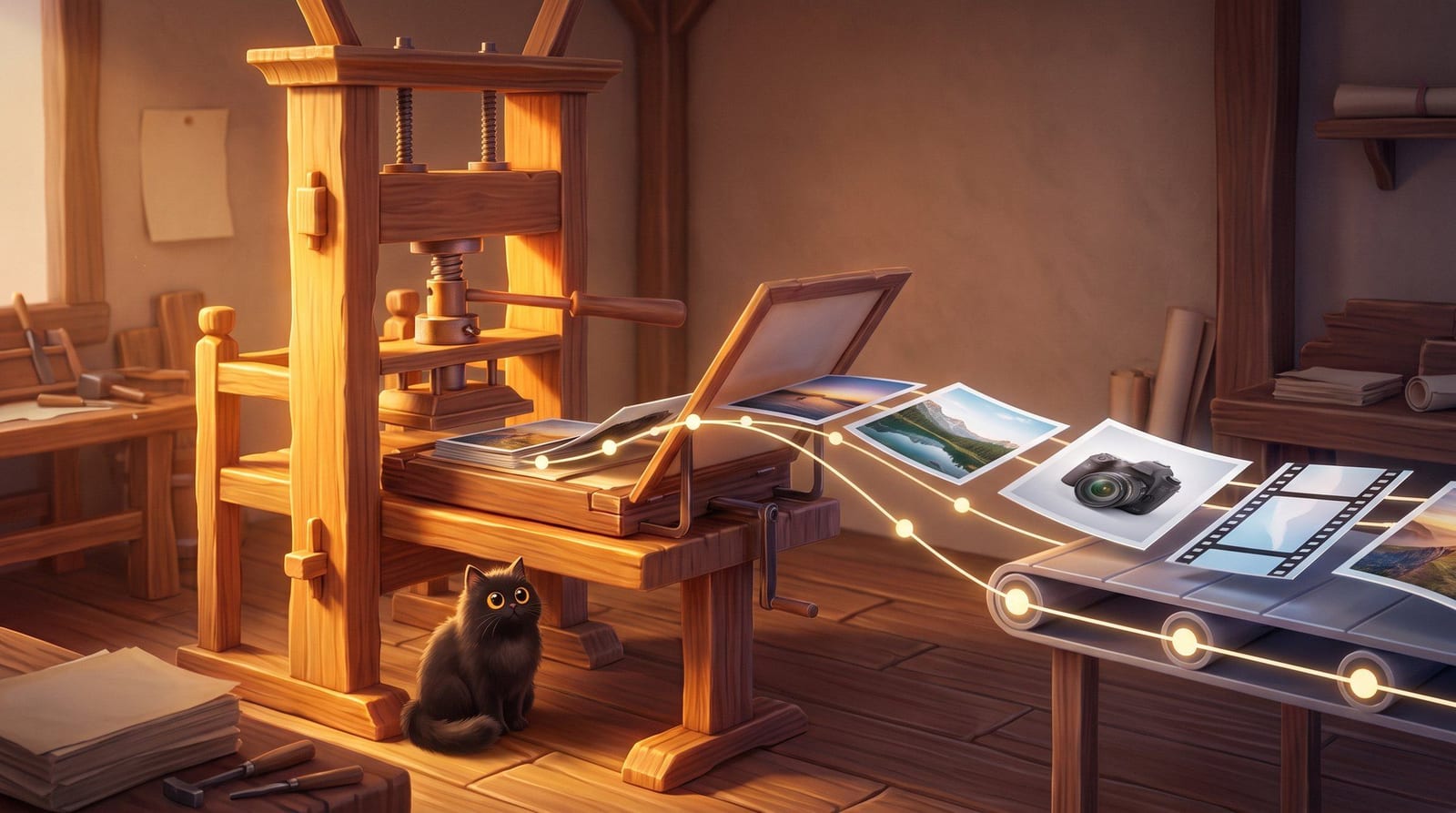
When Gutenberg brought the printing press to Europe in the 1450s, the shift wasn't simply faster printing. It was repeatable. Set the type once, then use it to reproduce the same text hundreds of times. Producing a book no longer meant copying every page by hand. And yet, early printed books still looked like handwritten manuscripts. The technology had changed, but people's idea of what they could do with it hadn't caught up.
Centuries later, AI has transformed how quickly we can create. Images, product shots and videos can be generated in seconds. But a great idea can still take weeks to ship. Every asset starts from a blank prompt. Re-explain the brand. Re-find the character. Rework the details until it feels right. We've made the output faster without fundamentally changing the process around it.
Every wave of technology shifts where value lies. Printing made copies cheap. Editors mattered more. The internet made distribution free. Curators won. AI makes pixels nearly free.
Taste is the new scarce thing.
Taste is knowing what good looks like, what makes it work and how to get there consistently. Yet, much of that knowledge remains trapped in people's heads, scattered across briefs, prompts and repeated creative decisions.
What if we could build the process, not just the output? What if the thinking, standards and steps behind great work could be captured once and carried into whatever comes next? Instead of rebuilding the process with every new idea, we could make each creation a starting point for the next.
We learned this while building ShopOS. Over the past year, we've built AI-powered creatives for brands, helping teams produce creative work more efficiently. That experience got us thinking about what comes after generation: what if the expertise behind great work could be put to use every time you create something new?
That's what we're building with Sloosh.
Sloosh is for anyone who wants to turn their creative style, hard-earned instincts or big ideas into a process they can return to, without needing a full creative team or knowing where to start. Different people, different ambitions, but a shared need: a way to turn what they know, imagine and create into something they can build on.
Sloosh puts a creative crew behind every idea through workflows we call Spaces. Bring any photo or video and run it through a Space built by us or a creator whose work you admire. Or build your own in Spacelab, turning your creative process into a workflow you can run again and again, while maintaining a consistent standard.
The idea is simple: say the outcome, keep the workflow. Your next creation shouldn't have to start from zero just because the brief has changed. And when a creative challenge needs more than another generation, human expertise can help bring it across the finish line.
This also opens up a new opportunity for creators.
We're entering an age where creators are more than the content they publish. They're tastemakers and culture-makers who shape what we see, what we like and how we create. Today, their taste largely lives in their content. With Sloosh, they can turn it into Spaces others can run, bringing their creative approach beyond their own content and audience. Each run creates an opportunity for them to earn rewards from the workflows they've built.
The next era of creativity won't be defined by how much AI can generate, but by how far human ingenuity can travel. The opportunity is to move at AI speed without letting everything look and feel the same. To make creative processes repeatable without making creativity itself generic.
Because when making becomes easy, what matters is knowing what to make, how to make it yours and how to make it happen again.
That's how we make AI fun again.
Got an idea? Sloosh it.
Try it in Sloosh
Make an image in Studio with what you just read.